

Bone Grafting & Sinus Lifts
Building a stable foundation for dental implants
A strong and healthy jawbone is essential for long-term dental implant success. After tooth loss, gum disease, infection or trauma, the surrounding bone may gradually reduce in height and width. When insufficient bone remains, bone grafting or sinus lift surgery may be recommended to create a stable foundation for implant placement.
Associate Professor Christian Freudlsperger and Mr Nigel Parr provide specialist oral and maxillofacial surgical care for patients requiring bone augmentation, sinus lift surgery and complex implant rehabilitation. Advanced 3D imaging, careful soft-tissue management and evidence-based grafting techniques are used to support predictable healing and long-term implant stability.
UNDERSTANDING THE CONDITION
Why is Bone Grafting needed?
Jawbone requires stimulation from the teeth to maintain its shape and volume. Following tooth loss, the surrounding bone naturally begins to shrink. This process may make future implant placement more difficult.
Bone loss may result from:
Long-term tooth loss
Periodontal or gum disease
Dental infection
Traumatic tooth loss or jaw injury
Failed implants or previous unsuccessful grafting
Long-term denture wear
Congenital or developmental conditions
Removal of cysts, tumours or other jaw lesions
Previous reconstructive surgery
Dental implants require adequate bone height, width and quality for stable placement. Bone grafting rebuilds the deficient area and helps position the implant in the most appropriate location for function, appearance and long-term maintenance.
What is a Sinus Lift?
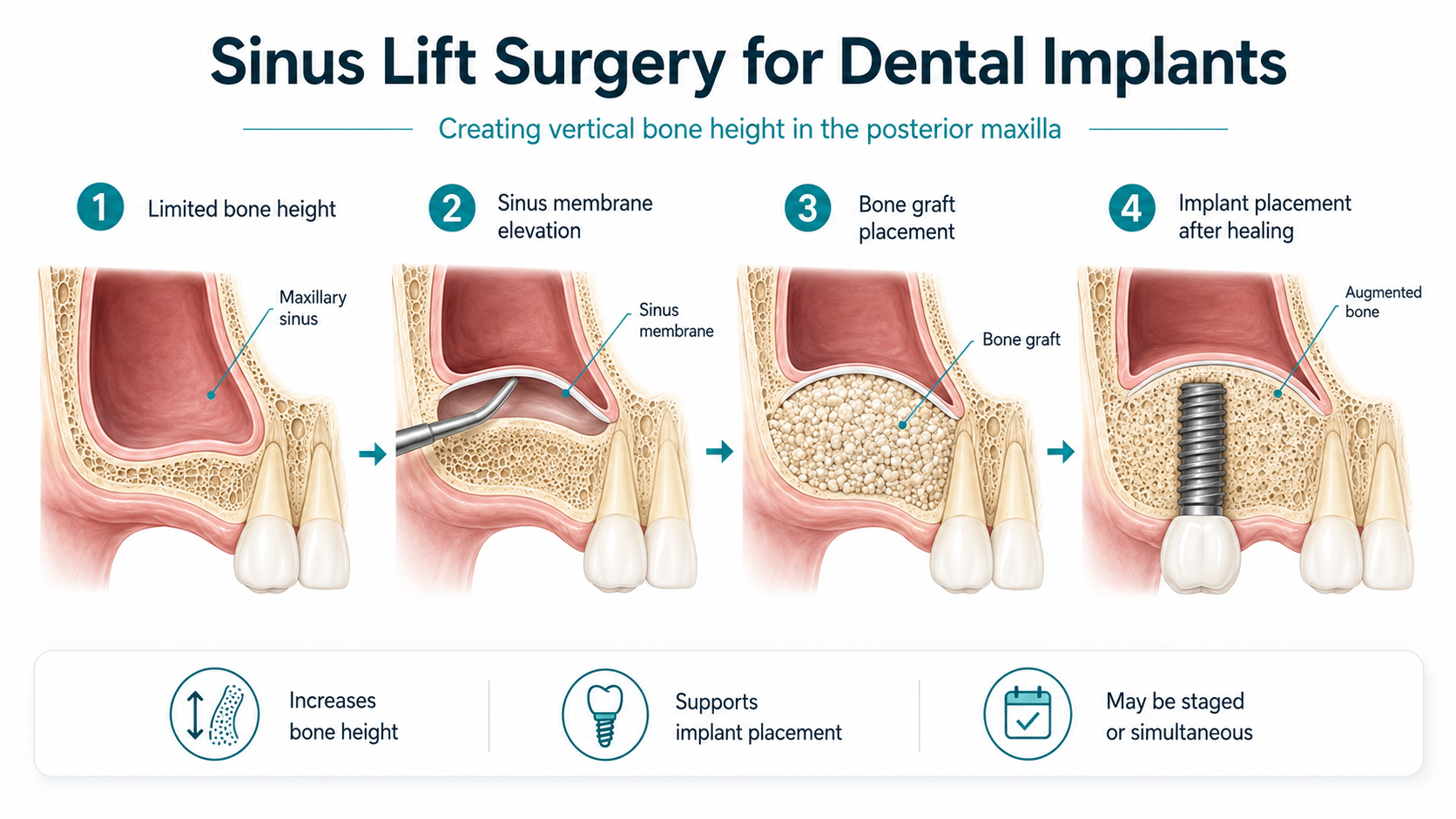
The maxillary sinuses are air-filled spaces located above the upper premolar and molar teeth. After these teeth are lost, the supporting bone may shrink while the sinus gradually expands downward. This can leave insufficient bone height for conventional implant placement.
A sinus lift, also known as sinus floor augmentation, gently elevates the sinus lining and places graft material beneath it. Over time, new bone develops within this space, creating additional support for one or more dental implants.
Sinus lift surgery may be performed before implant placement or at the same appointment, depending on the amount and quality of the remaining bone.
Types of Bone Grafts
Autogenous (Autograft): Bone is taken from another area of the patient’s body, commonly from within the upper or lower jaw. For more extensive reconstruction, bone may occasionally be harvested from another site, such as the hip.
The patient’s own bone contains living cells and natural growth factors, but it requires an additional surgical site.
Allograft: Processed human donor bone from tissue banks. Safe, effective, and eliminates the need for a second surgical site.
Xenograft: Bone derived from animal sources (typically bovine), processed to remove organic components. Excellent scaffold for new bone growth.
Alloplast: Synthetic bone substitute materials designed to mimic natural bone structure and promote new bone formation.
The choice depends on the grafting location, amount needed, and individual patient factors.
PROCEDURE & TREATMENT OPTIONS
Assessment & Planning
Treatment begins with a detailed clinical assessment and review of your dental and medical history.
Planning may include:
Examination of the teeth, gums and bite
Review of previous dental treatment or implant failure
OPG or panoramic imaging
Cone Beam CT imaging for accurate three-dimensional assessment
Digital intraoral scans
Evaluation of the sinus anatomy and health
Assessment of available bone height, width and density
Coordination with the referring dentist, prosthodontist and dental technician
Digital planning helps determine whether grafting is required, the amount of bone needed and whether implant placement can be performed at the same time.
For referring clinicians, restoration-driven planning supports appropriate implant positioning and coordinated surgical and restorative treatment.
Bone Grafting Procedures
Socket Preservation: After a tooth is removed, graft material may be placed within the extraction socket to reduce bone shrinkage and preserve the ridge for future implant placement.
Socket preservation does not prevent all bone loss, but it may reduce the extent of future grafting required.
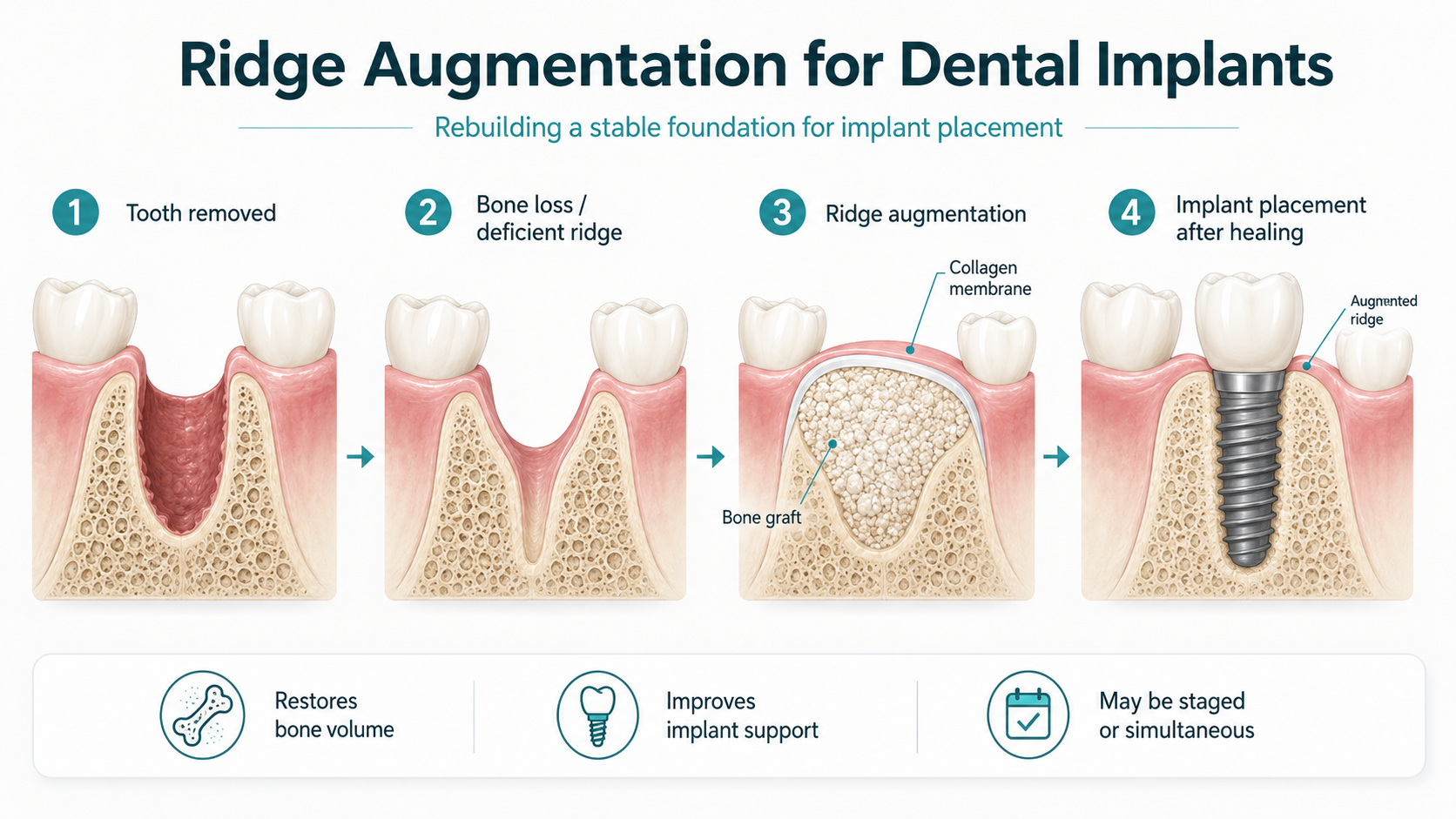
Ridge Augmentation: Horizontal or vertical ridge augmentation is used when the jaw is too narrow or too low to support an implant.
Graft material is placed around the deficient area and is often protected with a collagen membrane. Small screws or fixation devices may be used to stabilise larger grafts.
Onlay/Inlay Grafts: For more substantial deficiencies, a block of bone may be secured to the existing jawbone to increase its height or width. The graft is allowed to heal and integrate before implant placement.
Guided Bone Regeneration: Guided bone regeneration combines grafting material with a protective membrane to create and maintain space for new bone growth. It may be used before or at the same time as implant placement.
Sinus Lift Procedures: Two approaches exist depending on bone height:
Lateral Window Approach: A small opening is created through the side wall of the upper jaw. The sinus lining is carefully elevated, and graft material is placed beneath it.
This approach is generally used when substantial additional bone height is required. Implants may be placed at the same time if sufficient native bone remains for initial stability, or after the graft has healed.
Crestal Approach (Osteotome Technique): Where only a modest increase in bone height is required, the sinus may be elevated through the planned implant site.
This less extensive approach may allow grafting and implant placement to be completed together in selected cases.
Why Choose Oral & Facial Surgery, Remuera?
Specialist Reconstructive Expertise: Associate Professor Christian Freudlsperger and Mr Nigel Parr are specialist oral and maxillofacial surgeons experienced in bone grafting, sinus lift surgery, complex implant placement and reconstruction of severely deficient jaws.
Advanced 3D Assessment and Planning: CBCT imaging, digital scans and restoration-driven planning help determine the required bone volume, protect important structures and position implants accurately.
Comprehensive Grafting Options: Treatment ranges from socket preservation and minor ridge augmentation to block grafting, complex sinus augmentation and reconstruction following trauma, infection or previous surgery.
Coordinated Referral Care: We work closely with referring dentists, prosthodontists, periodontists and dental technicians to coordinate grafting, implant placement, restoration and long-term maintenance.
RISKS & RECOVERY
Understanding the Risks
Bone grafting and sinus lift surgery are well-established procedures, but all surgery carries some risk.
Possible complications include:
Pain, swelling and bruising
Bleeding or infection
Delayed wound healing
Exposure or loss of grafting material
Incomplete graft integration or insufficient new bone formation
Need for repeat grafting or additional surgery
Gum recession or alteration of the soft-tissue contour
Temporary or, rarely, permanent altered sensation
Damage to neighbouring teeth or roots
Sinus membrane perforation
Sinusitis or persistent sinus symptoms
Communication between the mouth and sinus
Implant failure if implant placement is performed simultaneously
Smoking, poor oral hygiene, uncontrolled diabetes, active gum disease and certain medications can increase the risk of complications.
Your surgeon will explain the expected benefits, limitations, alternatives and individual risks before treatment.
A/Prof Freudlsperger and Mr Nigel Parr will discuss all potential risks, benefits, and alternatives specific to your individual case in detail during your consultation, ensuring you have a complete understanding before proceeding with treatment.
What to Expect During Recovery
First Week: Expect moderate swelling peaking at 48-72 hours, manageable discomfort with prescribed medication, possible bruising, minor bleeding, and nasal congestion or drainage if sinus lift performed. Apply ice packs, maintain soft diet, avoid nose blowing if sinus lift performed, and rest adequately.
Weeks 2-4: Swelling resolves, discomfort diminishes significantly, gradual return to normal diet (avoiding graft site initially), and suture removal if non-dissolvable used.
Months 1-4: Graft consolidation period. Minimal external changes but critical bone formation occurring internally. Avoid trauma to the area.
Months 4-9: Complete graft maturation. Follow-up imaging confirms adequate bone formation before implant placement.
Post-Operative Care
Success depends on careful adherence to instructions: take all prescribed medications (antibiotics particularly important), avoid disturbing graft site, maintain excellent oral hygiene (gentle initially), follow soft diet advancing as tolerated, avoid smoking (dramatically impairs healing and graft integration), no nose blowing or creating pressure if sinus lift performed (sneeze with mouth open), avoid strenuous activity for one week, and attend all follow-up appointments.
Patience during healing is essential—rushing to implant placement before adequate bone formation compromises success.Bone grafting and sinus lift surgery are well-established procedures, but all surgery carries some risk.
Important measures include:
Taking prescribed antibiotics and pain relief as directed
Maintaining good oral hygiene without disturbing the wound
Using mouth rinses where recommended
Following dietary instructions
Avoiding smoking and vaping
Avoiding pressure from dentures over the graft
Following sinus precautions after sinus lift surgery
Attending all scheduled follow-up appointments
Bone regeneration takes time. Allowing the graft to mature fully before placing or loading an implant helps create a stronger and more predictable foundation for long-term treatment.
Smoking, poor oral hygiene, uncontrolled diabetes, active gum disease and certain medications can increase the risk of complications.
Your surgeon will explain the expected benefits, limitations, alternatives and individual risks before treatment.
BOOK YOUR APPOINTMENT
Ready to Build a Strong Foundation for your Dental Implants?
If you have been told that there is insufficient bone for dental implants, require a sinus lift or need assessment following failed grafting or implant treatment, please contact Oral & Facial Surgery to arrange a specialist consultation.
We welcome referrals from dentists, prosthodontists, periodontists, orthodontists, medical specialists and general practitioners.