

Osteonecrosis & Inflammatory Jaw Bone Disorders
Specialist assessment for complex jawbone conditions
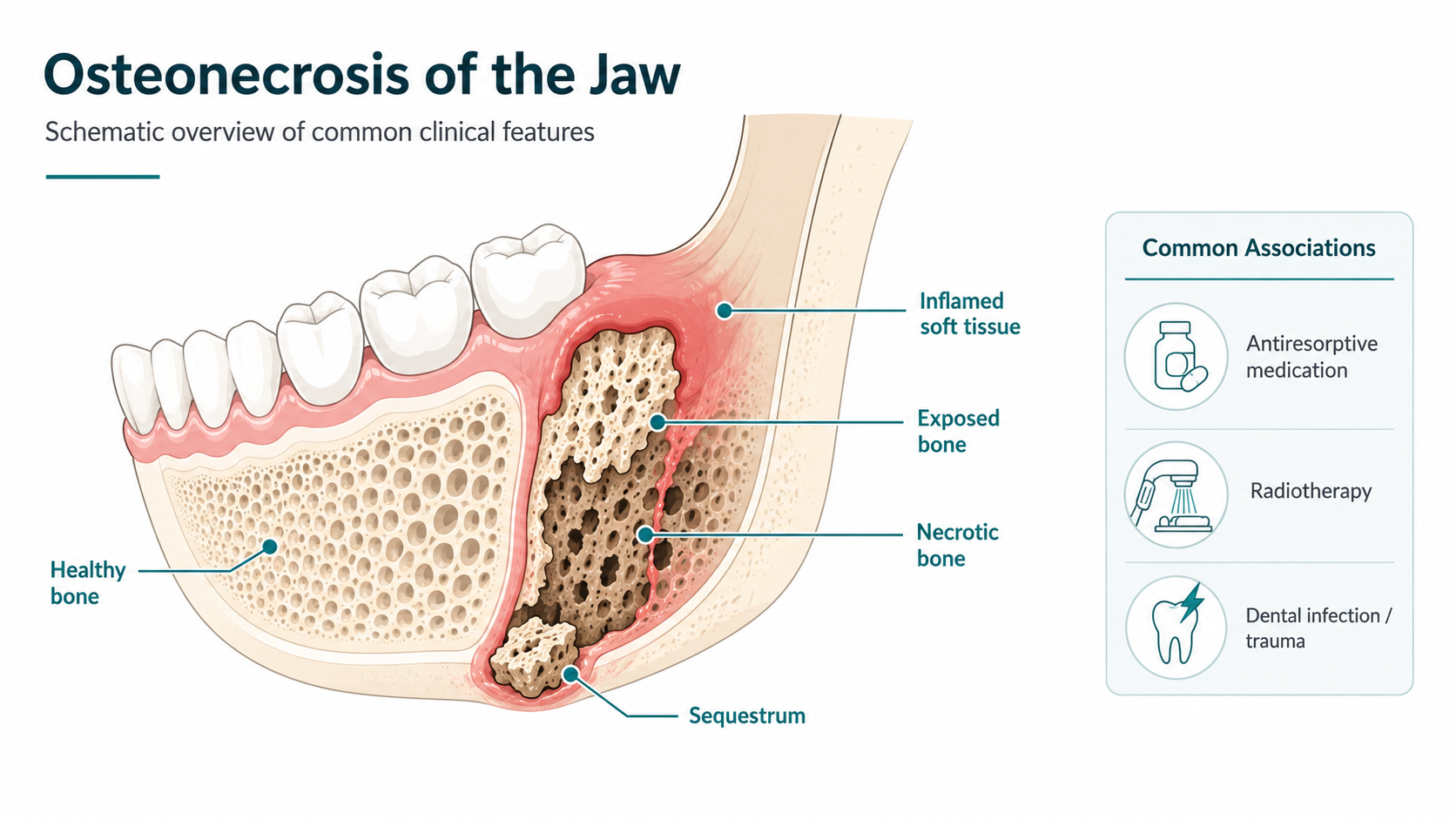
Osteonecrosis and inflammatory disorders of the jaw can cause persistent pain, infection, exposed bone and delayed healing. They may occur in association with certain medications, previous radiotherapy, chronic dental infection, trauma or other medical treatment.
Early assessment, accurate diagnosis and coordinated care are important to control symptoms, reduce progression and preserve oral function. Associate Professor Christian Freudlsperger and Mr Nigel Parr provide specialist oral and maxillofacial assessment and treatment for these complex conditions.
UNDERSTANDING THE CONDITION
What is jaw osteonecrosis?
Osteonecrosis describes an area of jawbone that has become damaged and is not healing normally. The most common forms include:
Medication-related osteonecrosis of the jaw (MRONJ), associated with medicines such as bisphosphonates, denosumab and some antiangiogenic therapies
Osteoradionecrosis following radiotherapy to the head and neck
Chronic osteomyelitis caused by persistent inflammation or infection within the jawbone
Other inflammatory or healing disorders associated with dental infection, trauma or impaired immunity
Antiresorptive medications provide important benefits in the treatment of osteoporosis and cancer-related bone disease. Patients should not stop these medicines without advice from the prescribing medical specialist. Any change in treatment should be considered jointly by the patient’s medical and dental teams.
Common signs and symptoms
Exposed or visible bone that does not heal
Persistent jaw pain, swelling or tenderness
Delayed healing following a dental extraction
Recurrent infection, discharge or an unpleasant taste
Loose teeth without an obvious dental cause
A non-healing sore, ulcer or draining sinus
Numbness, tingling or a heavy feeling in the jaw
Sinus symptoms associated with an upper-jaw condition
Jawbone disease can occasionally develop without visible exposed bone. Persistent or unexplained symptoms should therefore be assessed, particularly in patients who have received antiresorptive medication, cancer therapy or head and neck radiotherapy.
PROCEDURE & TREATMENT OPTIONS
Diagnosis and Assessment
Assessment includes a detailed medical, medication and dental history together with careful examination of the teeth, gums and jaw.
An OPG, CBCT or medical CT scan may be recommended to assess the extent of the condition and its relationship to the teeth, nerves and sinuses. A biopsy or tissue sample may occasionally be required to confirm the diagnosis or exclude another condition.
We work closely with the patient’s dentist, GP, oncologist, haematologist, endocrinologist or radiation oncologist to ensure that treatment is aligned with their overall medical care. Imaging is particularly valuable because jawbone changes may extend beyond what is visible during clinical examination.
Treatment Approach
Treatment is tailored to the cause, severity, symptoms and general health of the patient. Options may include:
Individualised oral-hygiene support
Antimicrobial mouth rinses
Antibiotics where infection is present
Pain management
Smoothing or removal of loose bone fragments
Surgical debridement or removal of affected bone
Soft-tissue closure and reconstruction where required
Dental and oral rehabilitation following healing
Surgery is not required for every patient. Conservative care may be appropriate for selected stable or minimally symptomatic conditions, while persistent, infected or progressive disease may require surgical management. The expected benefits, limitations and alternatives will be discussed individually.
Preventive dental care is also important. Patients who are about to begin antiresorptive medication or head and neck radiotherapy may benefit from dental assessment and treatment of active infection beforehand. When extraction is required in a patient receiving antiresorptive medication, careful surgical technique, management of sharp bone edges and secure wound closure may reduce complications.
Why Choose Oral & Facial Surgery, Remeura?
Specialist Jawbone Expertise: Associate Professor Christian Freudlsperger and Mr Nigel Parr are specialist oral and maxillofacial surgeons experienced in managing complex infections, osteonecrosis and compromised jawbone.
Clinical and Research Experience: Associate Professor Freudlsperger has extensive clinical and research experience in medication-related osteonecrosis, osteoradionecrosis, fluorescence-guided bone surgery, wound closure and reconstructive treatment.
Comprehensive Treatment Options: Care ranges from monitoring and minor sequestrectomy to advanced debridement, jaw reconstruction and oral rehabilitation, allowing treatment to be matched to the severity of the condition.
Coordinated Multidisciplinary Care: We communicate closely with dentists, GPs, oncologists, haematologists, endocrinologists and other specialists so that oral treatment is safely coordinated with osteoporosis or cancer therapy. Interdisciplinary communication is a central part of prevention, diagnosis and management.
SURGICAL RISKS
Understanding the Risks
The risks depend on the underlying condition and the treatment required. These may include pain, swelling, bleeding, infection, delayed wound healing, altered sensation, sinus involvement, recurrence or progression of the disease and the need for further surgery.
More advanced disease may weaken the jawbone or require removal and reconstruction of a larger area. Your surgeon will explain the expected benefits, risks and alternatives relevant to your individual circumstances before treatment.
Why Specialist Care Matters
Jawbone disorders are often influenced by several dental and medical factors. Specialist oral and maxillofacial care helps balance treatment of the jaw condition with the safe continuation of essential osteoporosis, oncology or other medical therapy.
Early referral is particularly recommended for patients with exposed bone, a non-healing extraction site, unexplained jaw pain or swelling, recurrent infection or altered sensation. Early diagnosis and appropriate management may help prevent more extensive disease and support earlier dental rehabilitation.
Selected research and publications
Bodem JP, Kargus S, Eckstein S, Saure D, Engel M, Hoffmann J, Freudlsperger C. Incidence of bisphosphonate-related osteonecrosis of the jaw in high-risk patients undergoing surgical tooth extraction. J Craniomaxillofac Surg. 2015;43(4):510–514. doi: 10.1016/j.jcms.2015.02.018. PMID: 25841311.
Bodem JP, Kargus S, Engel M, Hoffmann J, Freudlsperger C. Value of nonsurgical therapeutic management of stage I bisphosphonate-related osteonecrosis of the jaw. J Craniomaxillofac Surg. 2015;43(7):1139–1143. doi: 10.1016/j.jcms.2015.05.019. PMID: 26116306.
Bodem JP, Schaal C, Kargus S, Saure D, Mertens C, Engel M, Hoffmann J, Freudlsperger C. Surgical management of bisphosphonate-related osteonecrosis of the jaw stages II and III. Oral Surg Oral Med Oral Pathol Oral Radiol. 2016;121(4):367–372. doi: 10.1016/j.oooo.2015.10.033. PMID: 26795450.
Ristow O, Otto S, Geiß C, Kehl V, Berger M, Troeltzsch M, Koerdt S, Hohlweg-Majert B, Freudlsperger C, Pautke C. Comparison of auto-fluorescence and tetracycline fluorescence for guided bone surgery of medication-related osteonecrosis of the jaw: a randomized controlled feasibility study. Int J Oral Maxillofac Surg. 2017;46(2):157–166. doi: 10.1016/j.ijom.2016.10.008. PMID: 27856150.
Ristow O, Rückschloß T, Bodem J, Berger M, Bodem E, Kargus S, Engel M, Hoffmann J, Freudlsperger C. Double-layer closure techniques after bone surgery of medication-related osteonecrosis of the jaw: a single-centre cohort study. J Craniomaxillofac Surg. 2018;46(5):815–824. doi: 10.1016/j.jcms.2018.03.005. PMID: 29631942.
Ristow O, Rückschloß T, Müller M, Berger M, Kargus S, Pautke C, Engel M, Hoffmann J, Freudlsperger C. Is the conservative non-surgical management of medication-related osteonecrosis of the jaw an appropriate treatment option for early stages? A long-term single-centre cohort study. J Craniomaxillofac Surg. 2019;47(3):491–499. doi: 10.1016/j.jcms.2018.12.014. PMID: 30642734.
Ristow O, Nehrbass D, Zeiter S, Arens D, Moratin J, Pautke C, Hoffmann J, Freudlsperger C, Otto S. Differences between auto-fluorescence and tetracycline fluorescence in medication-related osteonecrosis of the jaw: a preclinical proof-of-concept study in the mini-pig. Clin Oral Investig. 2020;24(12):4625–4637. doi: 10.1007/s00784-020-03332-2. PMID: 32444918.
Ristow O, Rückschloß T, Moratin J, Müller M, Kühle R, Dominik H, Pilz M, Shavlokhova V, Otto S, Hoffmann J, Freudlsperger C. Wound closure and alveoplasty after preventive tooth extractions in patients with antiresorptive intake: a randomized pilot trial. Oral Dis. 2021;27(3):532–546. doi: 10.1111/odi.13556. PMID: 32875698.
Ristow O, Hürtgen L, Moratin J, Smielowski M, Freudlsperger C, Engel M, Hoffmann J, Rückschloß T. A critical assessment of the medication-related osteonecrosis of the jaw classification in stage I patients: a retrospective analysis. J Korean Assoc Oral Maxillofac Surg. 2021;47(2):99–111. doi: 10.5125/jkaoms.2021.47.2.99. PMID: 33911042.

BOOK YOUR APPOINTMENT
Oral & Facial Surgery Auckland
If you have been referred for assessment of a jaw bone concern, or you have symptoms that concern you, please contact the practice to arrange a consultation. Bringing a list of current and past medications, along with any recent scans, will help make the most of your first visit.